Palorchestes Pronunciation
Picture, name meaning, and how to say Palorchestes. Free guide for kids and parents.
How to Pronounce Palorchestes
pal-or-KES-teez
ALL CAPS = stressed syllable
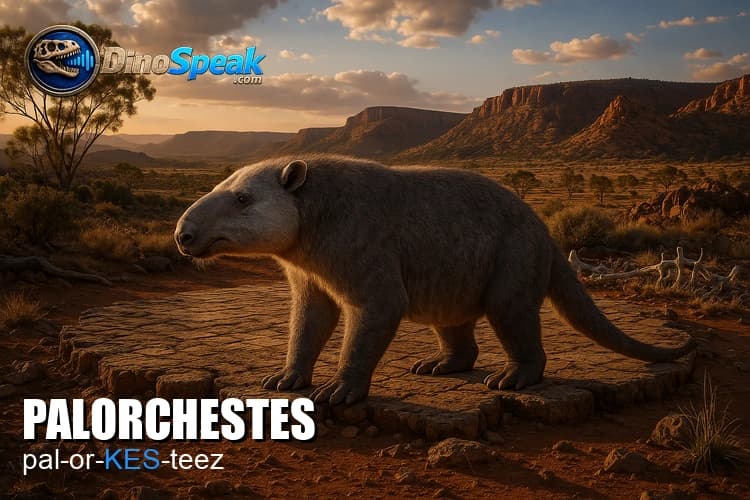
What does Palorchestes mean?
Ancient leaping creature from Australia
Name Roots
"paleo (palaios)"
ancient, old: Greek origin
"orchestes"
dancer or leaper: Greek origin, from orcheomai meaning to dance
Fun Facts
- ✓Palorchestes was initially mistaken for a giant kangaroo when it was first described by Richard Owen in 1873, because the earliest fossils found were jaw fragments that fooled scientists for decades.
- ✓Its retracted nasal bones are a key clue that it had a tapir-like prehensile lip or possibly even a short trunk, which it likely used to pull branches and leaves into its mouth.
- ✓Palorchestes survived for nearly 16 million years, outlasting countless other prehistoric giants, before disappearing around 11,700 years ago, coinciding with the arrival of humans in Australia.
- ✓Despite being related to wombats and koalas through the Vombatomorphia group, Palorchestes looked nothing like either of them, demonstrating just how wildly different marsupial evolution can get.
- ✓The largest species, Palorchestes azael, could weigh up to an estimated 1,000 kilograms, making it one of the heaviest marsupials known to science, heavier than a modern bison.

Period
Miocene to Late Pleistocene
15.98-0.0117 MYA

Diet
Herbivore

Size
8 ft (2.5 m)
2,200 lbs (1,000 kg)

Type
Vombatomorphia