
Pteranodon vs Pterodactyl
Most people use these two names like they mean the same thing. They don't.
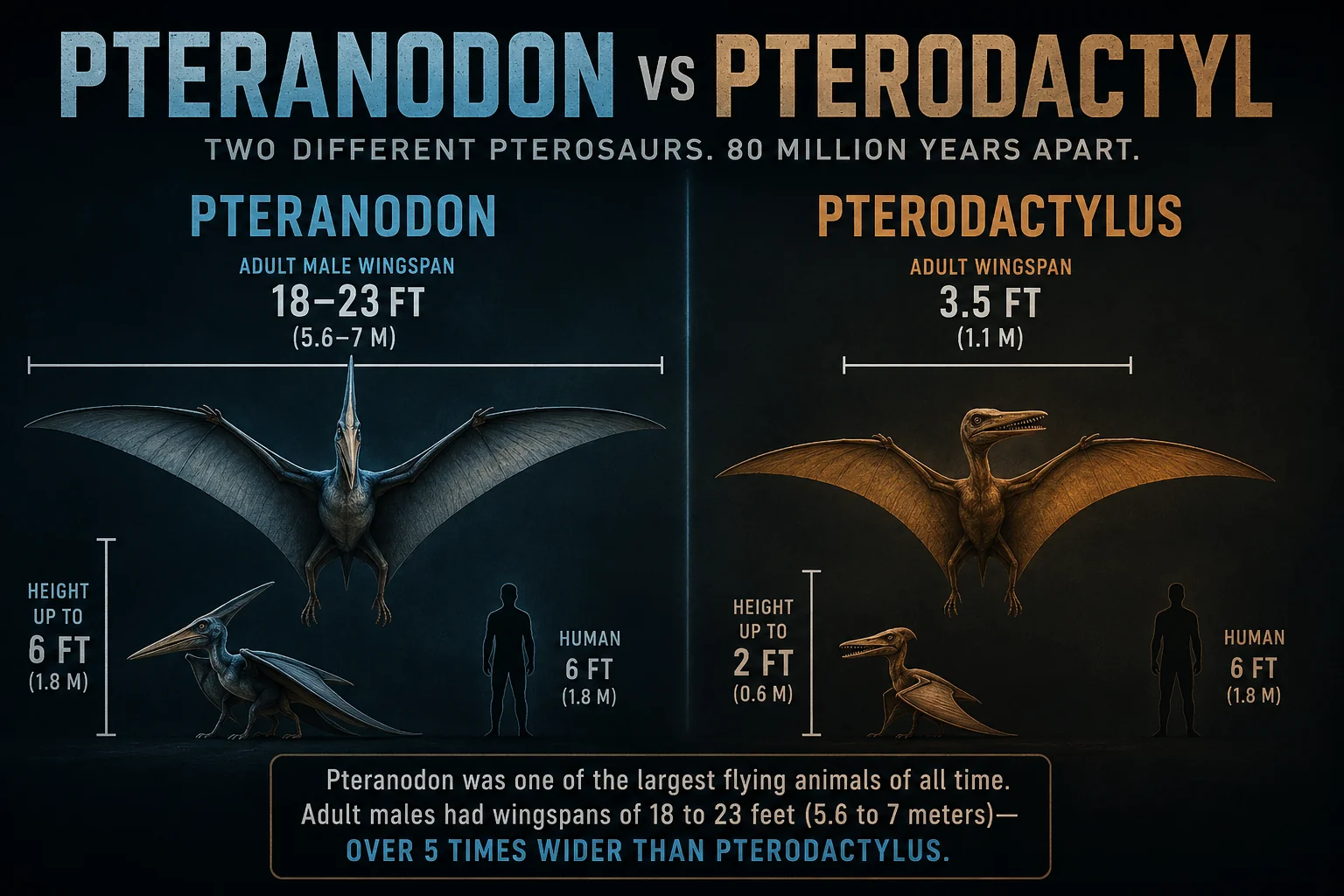
Pteranodon and Pterodactyl were two completely different flying reptiles separated by about 80 million years of evolution. One had teeth and was roughly the size of a large hawk. The other had no teeth, a wingspan of up to 23 feet, and one of the most recognizable head crests in prehistoric life.
Both were pterosaurs — flying reptiles that lived alongside dinosaurs but were not dinosaurs themselves. Here is exactly how they were different, with pictures and step-by-step pronunciation guides for both.
Pteranodon and Pterodactyl Pictures
See All Pterosaurs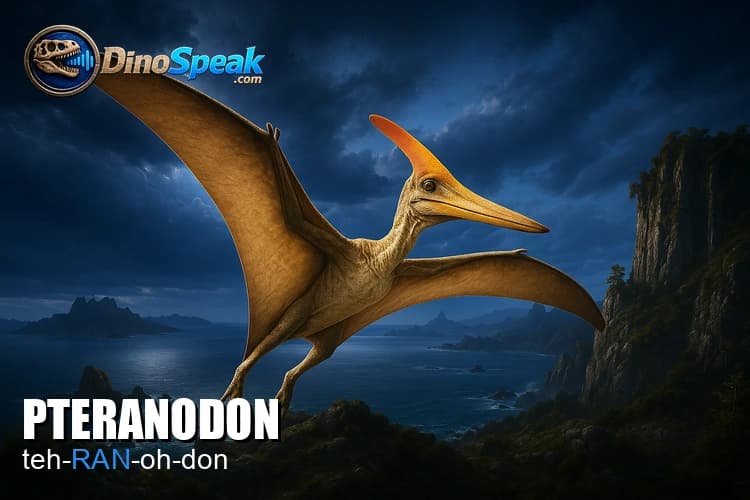
The Key Differences Between Pteranodon and Pterodactyl
The most important difference is size. Pterodactylus had a wingspan of roughly 3.5 feet — about the same as a large red-tailed hawk. Pteranodon had a wingspan of up to 23 feet, more than six times larger. Standing side by side they would look like completely different kinds of animals.
The second big difference is teeth. Pterodactylus had small, sharp teeth lining both jaws — useful for grabbing slippery fish and insects. Pteranodon had no teeth at all. Its name literally means toothless wing in Greek. Instead of teeth it had a long, smooth beak, which it used like a spear to snatch fish from the surface of the ancient Western Interior Seaway.
The third difference is time. Pterodactylus lived in the Late Jurassic, about 150 million years ago, in what is now Germany. Pteranodon lived in the Late Cretaceous, about 84 to 72 million years ago, in what is now the midwestern United States. They never shared the same sky. Calling them the same animal is like calling a wolf and a golden retriever identical because both are canines.
What Was Pterodactylus?
Pterodactylus, often called Pterodactyl for short, was one of the first prehistoric flying reptiles ever described by science. Italian naturalist Cosimo Alessandro Collini found the first fossil in 1784 and had no idea what it was — he initially thought it might be a sea creature. It was not until 1809 that Georges Cuvier correctly identified it as a flying animal.
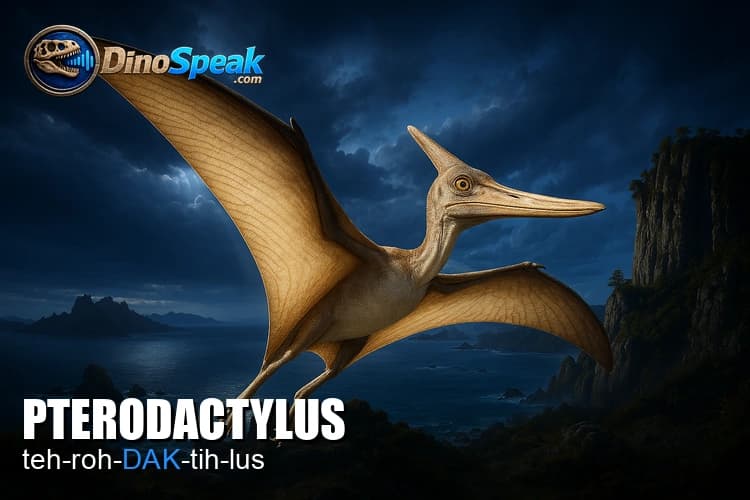
Pterosaur is pronounced TAIR-oh-DAK-til. The P is completely silent, which trips people up constantly. The name means winged finger in Greek, which is a precise description: pterosaur wings were stretched across an enormously elongated fourth finger, not across feathers or a rigid frame like a bat or a bird.
Pterosaur was relatively small, lightly built, and probably ate fish, insects, and small animals near Jurassic coastlines and lagoons. The fossils most associated with Pterodactylus come from the Solnhofen Limestone in Bavaria, Germany — the same formation that produced Archaeopteryx and some of the most detailed fossil specimens ever found.
What Was Pteranodon?
Pteranodon is one of the most studied flying animals in Earth's history. Over 1,200 specimens have been found, most from the Niobrara Formation in Kansas — the chalky remains of the ancient Western Interior Seaway, a shallow sea that split North America down the middle during the Cretaceous Period.
Pteranodon is pronounced teh-RAN-oh-don. Again the P is silent. The name means toothless wing, which sets it apart immediately from Pterodactylus. Pteranodon's most iconic feature is the long bony crest extending backward from its skull like a counterbalance — the larger crests belonged to males, while females had smaller, rounder crests. This is one of the best-documented cases of sexual dimorphism in any extinct flying animal.
With a wingspan of up to 23 feet, Pteranodon was a serious predator of the ancient sea, swooping low over the waves to snatch fish with its toothless beak. It probably spent most of its life in the air, like a modern albatross, riding thermal updrafts over open water and only landing to nest.