
Terror Bird Facts
Imagine a bird taller than a basketball hoop, with a beak the size of a baseball bat, sprinting faster than Usain Bolt. That was a terror bird, and for 60 million years, they ruled South America as one of history's most successful apex predators. They were not dinosaurs, but they were every bit as fearsome.
Below you will find the most comprehensive terror bird facts resource on the internet, covering size, speed, diet, hunting, extinction, and every known species, all grounded in real paleontological research.
View All Terror BirdsHow Tall Were Terror Birds?
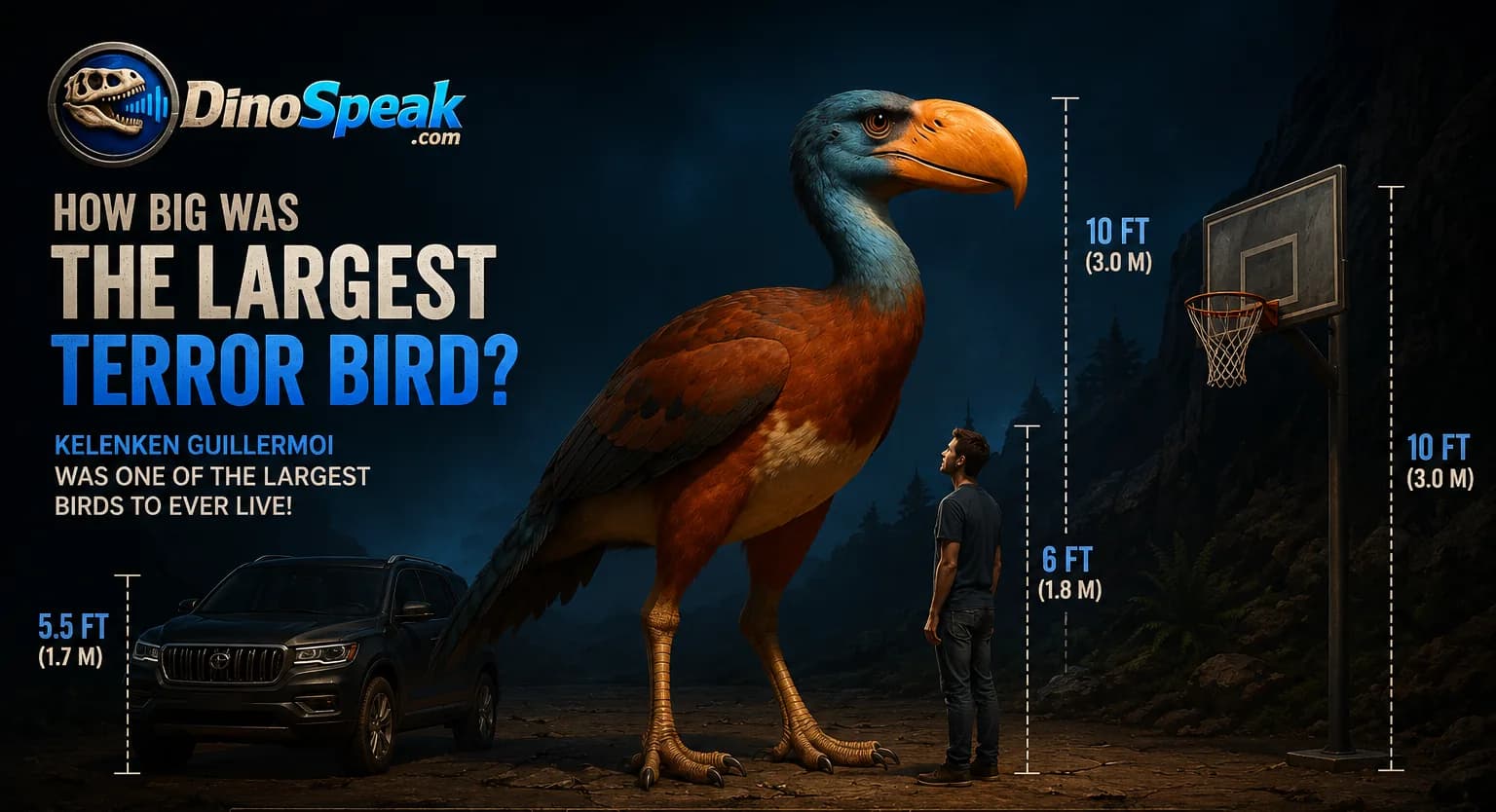
Terror birds ranged from about the size of a large turkey all the way up to nearly 10 feet tall, and the biggest ones could look over the top of a standard doorframe without even stretching. The largest confirmed species, Kelenken guillermoi, stood between 8 and 10 feet (2.5 to 3 meters) tall. A typical large terror bird like Phorusrhacos stood around 8 feet (2.4 meters), roughly 3 feet taller than the average adult human.
At the other end of the scale, the smallest species, Psilopterus, stood only 2 to 3 feet tall (60 to 90 cm), about the height of a large turkey or a small child. The terror bird family as a whole ranged from 1 to 3 meters in height across all known species.
Tallest terror bird: Kelenken guillermoi at nearly 10 feet (3 meters), as tall as an NBA basketball hoop
How Much Did Terror Birds Weigh?
Terror bird weight varied enormously across the family. The smallest species weighed as little as 5 to 9 kilograms (11 to 20 pounds), lighter than a typical house cat. Mid-sized species like Andalgalornis weighed around 40 kilograms (88 pounds), similar to a border collie. The iconic large species Phorusrhacos tipped the scales at roughly 130 kilograms (290 pounds), about the same as a large male gorilla or a baby grand piano.
The heaviest terror bird on record is Brontornis burmeisteri at an estimated 350 to 400 kilograms (770 to 880 pounds), close to the weight of a male polar bear, though its exact classification within the Phorusrhacidae family is still debated by scientists.
Heaviest terror bird: Brontornis burmeisteri at up to 880 lbs (400 kg), close to a male polar bear
How Fast Could Terror Birds Run?
Terror birds were built for speed. Their leg bones show a clear pattern: short upper legs (femur) combined with very long lower legs and foot bones, almost identical to modern ostriches. This is an anatomical design known to maximize stride length and running efficiency.
Conservative speed estimates for large species like Phorusrhacos put them at 30 to 48 kilometers per hour (18 to 30 mph), faster than the fastest human sprinter ever recorded. Usain Bolt peaked at about 28 mph during his world-record 100-meter dash, meaning even a mid-sized terror bird could likely have outrun him.
One species, Mesembriornis milneedwardsi, may have been in a league of its own. Leg bone analysis estimates its top speed at up to 97 km/h (60 mph), comparable to a cheetah, making it potentially the fastest runner of any bird ever known. Extreme speed estimates for some species reach as high as 90 km/h but remain scientifically disputed.
Fastest terror bird: Mesembriornis may have reached 60 mph (97 km/h), as fast as a cheetah
The Terror Bird Beak: Built Like an Axe
The beak was the terror bird's primary weapon, and it was extraordinary. Kelenken guillermoi possessed the largest bird skull ever discovered, 71 centimeters (28 inches) long, roughly the length of a baseball bat, and its beak alone measured 46 centimeters (18 inches), about the length of a human forearm from elbow to fingertip.
The beak was deep, narrow, laterally compressed (flattened side to side), and ended in a powerful downward hook, similar to an eagle's but far larger. Terror birds had lost all the flexible joint systems that most birds have in their skulls, turning those flexible connections into rigid beams. This meant the skull could not flex or absorb force. It was engineered to transmit force downward with brutal efficiency.
Scientists studying Andalgalornis found the skull was optimized for axe-like downward strikes, not biting and holding. The bird would drive its skull downward using powerful neck muscles, then pull back with the hooked tip, more like a pickaxe than a bite. The sickle-shaped toe claws could reach up to 15 centimeters (6 inches) long on large species and functioned as grappling hooks to pin struggling prey.
Kelenken's skull: 71 cm (28 inches) long, the largest bird skull ever found on Earth
What Did Terror Birds Eat and How Did They Hunt?
Terror birds were carnivores, but different species hunted very differently depending on their size and body plan. Small species like Psilopterus likely preyed on insects, lizards, and small vertebrates, similar to the behavior of their closest living relatives, the seriemas, which grab small prey and slam it against the ground repeatedly until it stops moving.
Mid-sized species such as Andalgalornis targeted notoungulates (extinct hoofed South American mammals) and animals up to the size of a large dog. The giant macropredators hunted mammals exceeding 100 kilograms (220 pounds).
Despite their fearsome reputation, terror birds did not have the bone-crushing bite force of a lion or wolf. Biomechanical studies of Andalgalornis measured its bite force at only 133 Newtons at the bill tip, roughly equal to a gray fox, weaker than most carnivorous mammals of similar size. They compensated entirely through speed and skull mechanics: strike fast, pull back, repeat. Scientists think they used an attack-and-retreat strategy, delivering rapid downward jabs and disengaging quickly rather than grappling with struggling prey.
Terror bird bite force: only 133 Newtons, weaker than a gray fox, but the beak struck like an axe
Terror Bird Senses: Sight, Sound, and Balance
The most complete terror bird fossil ever found is Llallawavis scagliai, discovered in Argentina in 2010 and over 90 percent preserved. CT scanning of its inner ear revealed it was a very agile predator, capable of fast head movements, which are indispensable to gaze stabilization during pursuit of prey.
Its hearing sensitivity peaked around 2,300 Hz, a low-frequency range similar to modern ostriches and emus. This suggests terror birds could detect prey at considerable distances and likely communicated using deep, rumbling calls that carried far across open grasslands. The inner ear structure also confirms that Llallawavis and its relatives were pursuit predators, capable of rapidly tracking moving targets with their eyes as they gave chase.
Most complete fossil: Llallawavis scagliai, over 90% preserved, including voice box, inner ear, and trachea
When Did Terror Birds Live?
Terror birds first appeared approximately 60 to 62 million years ago, not long after the mass extinction that wiped out the non-avian dinosaurs 66 million years ago. The oldest known species, Paleopsilopterus itaboraiensis, comes from Brazil and dates to roughly 60 million years ago.
The confirmed fossil record runs from around 43 million years ago (Middle Eocene) all the way to the Late Pleistocene, the same era when woolly mammoths and saber-toothed cats roamed the Earth. The last confirmed terror bird record is a Psilopterus specimen from Uruguay dated to approximately 96,000 years ago. A disputed specimen may be as recent as 17,500 years ago, but this has not been widely accepted.
At their peak, during the Miocene epoch (roughly 23 to 5 million years ago), terror birds were the dominant land predators across South America. They survived for approximately 60 million years, an extraordinary reign for any animal family.
Terror birds ruled for roughly 60 million years, from shortly after the dinosaurs died until the Ice Age
Where Did Terror Birds Live?
The vast majority of Phorusrhacidae fossils come from South America, with Argentina providing the most abundant and best-preserved specimens. Brazil and Uruguay have also yielded significant finds. For most of their history, terror birds were confined to South America, which was an isolated continent like Australia today, with no large carnivorous placental mammals competing with them.
This isolation is precisely why terror birds grew so large and dominated for so long. There was nothing else filling the apex predator role. When the Isthmus of Panama formed approximately 3 million years ago, connecting North and South America, one species, Titanis walleri, crossed north. Titanis fossils have been found in both Texas (dated to roughly 5 million years ago) and Florida (dated to 2.2 to 1.8 million years ago), making it the only terror bird known from North America.
Titanis walleri is the only terror bird ever found in North America, with fossils from Texas and Florida
All Terror Bird Species: A Complete Overview
Scientists currently recognize at least 18 to 20 species of terror birds across 14 genera, organized into 5 subfamilies. The subfamilies are: Brontornithinae (the giants, including Brontornis and Paraphysornis), Phorusrhacinae (large predators including Kelenken and Phorusrhacos), Patagornithinae (mid-sized runners including Andalgalornis and Devincenzia), Mesembriornithinae (medium-sized, including Mesembriornis and Llallawavis), and Psilopterinae (the smallest cursorial species, including Psilopterus and Procariama).
The smallest species, Psilopterus lemoinei, weighed as little as 5 kilograms and stood under 80 centimeters tall. The largest confirmed species by height was Kelenken guillermoi at up to 3 meters. The heaviest was Brontornis burmeisteri at up to 400 kilograms, though its exact family membership is debated. No two same-sized species appear to have co-existed in the same geographic area at the same time, a pattern called niche partitioning that was established very early in the family's evolution.
At least 18 species across 5 subfamilies, ranging from the size of a turkey to nearly 10 feet tall
Why Did Terror Birds Go Extinct?
Terror birds did not disappear overnight. Their decline unfolded over millions of years as their world changed around them. The most important event was the formation of the Isthmus of Panama approximately 3 million years ago, which connected North and South America for the first time.
This triggered the Great American Biotic Interchange. North American predators, including saber-toothed cats, wolves, and bears, poured south into South America, bringing intense competition that terror birds had never faced before. These new arrivals were specialists in grappling with and killing large prey, using lateral jaw-shaking and bone-crushing bite strategies that terror birds' skull anatomy made impossible for them to match. Simultaneously, global climate was cooling and drying, converting habitats and reducing the populations of prey animals terror birds depended on.
The last known large terror birds disappear from the fossil record around 1.8 million years ago. The small Psilopterus lineage hung on until approximately 96,000 years ago in Uruguay, long after humans arrived elsewhere in the world. Terror birds were NOT driven extinct by humans, who reached the Americas far too late to have caused their extinction.
Terror birds were NOT driven extinct by humans. The last ones disappeared nearly 94,000 years before humans reached the Americas
Terror Birds vs. Other Prehistoric Predators
Terror birds were formidable, but they existed in a different era and place than most of the predators people compare them to. T. rex weighed 8 to 10 tons, roughly 25 times heavier than the largest terror bird, and the two animals never shared the same continent or time period, so a direct confrontation was impossible.
Against their actual contemporaries in South America, terror birds appear to have been dominant. For most of their history, there were simply no large carnivorous mammals on the continent to challenge them. When that changed with the arrival of North American predators 3 million years ago, terror birds began to lose ground.
Saber-toothed cats like Smilodon, which overlapped in time with the last terror birds, were likely better adapted to taking down large prey due to their flexible grappling forelimbs and devastating canine teeth. Note: Gastornis, a large flightless bird from Eocene Europe and North America, is often confused with terror birds but belongs to an entirely different order and is now believed to have been herbivorous.
T. rex weighed 8 to 10 tons, about 25 times heavier than the largest terror bird
Are Terror Birds Related to Dinosaurs?
Terror birds are birds, and birds are dinosaurs. Specifically, birds are the last surviving lineage of theropod dinosaurs. All birds alive today, from hummingbirds to ostriches, are technically dinosaurs. Birds evolved from small, feathered theropod dinosaurs approximately 160 million years ago, and the famous fossil Archaeopteryx shows a creature with feathered arms, a wishbone, and bird-like features alongside teeth and a long bony tail inherited from its dinosaur ancestors.
When the mass extinction wiped out the non-avian dinosaurs 66 million years ago, birds survived and went on to colonize almost every ecological niche on Earth. Terror birds' closest living relatives are not ostriches or eagles. They are seriemas, small birds about 80 centimeters (31 inches) tall that still live in South America today. Seriemas use a similar technique to what small terror bird species likely used: they grab small prey and slam it against the ground repeatedly until it is stunned or dead.
Birds ARE dinosaurs. They evolved from small feathered theropods about 160 million years ago
Fun Facts About Terror Birds for Kids
Terror birds could not fly. Their wings had shrunk into tiny, nearly useless structures over millions of years as their legs grew larger and stronger. Kelenken's beak was about the same length as a human arm from elbow to fingertip. Terror birds kept their killing claws sharp by holding them slightly off the ground while walking, the same trick used by Velociraptor.
The most complete terror bird fossil (Llallawavis) preserved not just bones but the actual voice box and trachea, meaning scientists could potentially estimate what these birds sounded like. A small terror bird species (Psilopterus) survived until roughly 96,000 years ago, meaning woolly mammoths and terror birds were alive at the same time. Terror birds dominated South America as top predators for longer than the entire span of time that has passed since the dinosaurs went extinct.
The last small terror birds survived until roughly 96,000 years ago, sharing the world with woolly mammoths