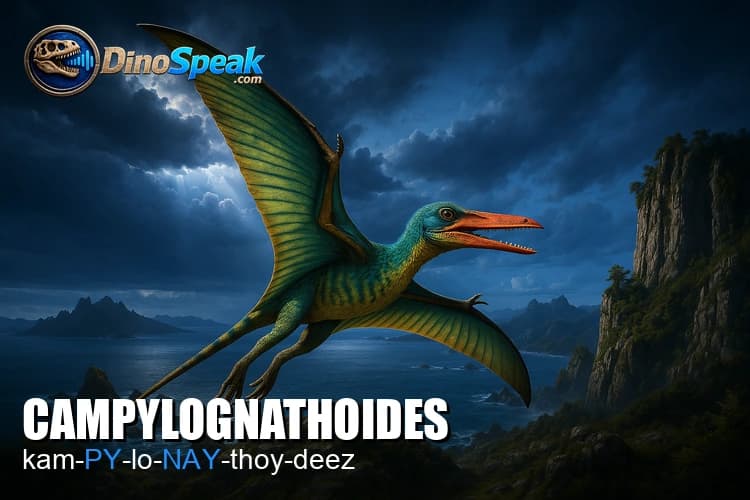
Campylognathoides Pronunciation
Picture, name meaning, and how to say Campylognathoides. Free guide for kids and parents.
How to Pronounce Campylognathoides
kam-PY-lo-NAY-thoy-deez
ALL CAPS = stressed syllable
What does Campylognathoides mean?
curved jaw form, ancient flying reptile
Name Roots
"kampylos"
curved, from Ancient Greek
"gnathos"
jaw, from Ancient Greek
"eides"
form or resemblance, from Ancient Greek
Fun Facts
- ✓The Holzmaden shale where Campylognathoides was found is so extraordinarily well-preserved that soft tissue impressions of pterosaur wing membranes have been documented from the same deposit, giving scientists rare clues about how these wings actually looked.
- ✓Campylognathoides was one of the earliest pterosaurs ever discovered, living approximately 182.9 million years ago during the Toarcian age of the Early Jurassic period.
- ✓Felix Plieninger, who formally named Campylognathoides in 1895, was a pioneering German paleontologist who recognized that the curved jaw shape was distinct enough from other known pterosaurs to warrant its own genus.
- ✓Unlike the famous Pteranodon which had no teeth, Campylognathoides had robust curved teeth, suggesting it was an active predator that snatched fish or small animals rather than filtering food.
- ✓The first specimen ever found consisted of only wing fragments, and it took additional, far better preserved skeletons from the Holzmaden shale before scientists could fully understand what this creature looked like.
Period
Early Jurassic
182.9 MYA
Diet
Carnivore
Size
up to 6 ft (1.8 m) wingspan
approx 2 lbs (0.9 kg)
Type
Pterosauria