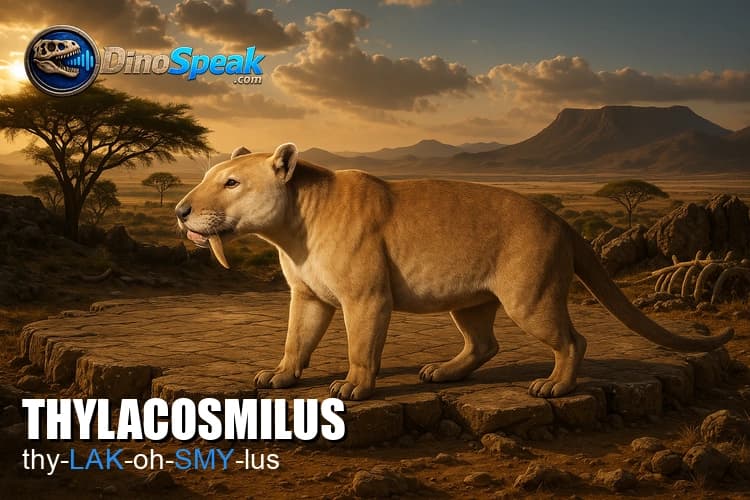
Thylacosmilus Pronunciation
Picture, name meaning, and how to say Thylacosmilus. Free guide for kids and parents.
How to Pronounce Thylacosmilus
thy-LAK-oh-SMY-lus
ALL CAPS = stressed syllable
What does Thylacosmilus mean?
pouched saber, marsupial-like knife tooth
Name Roots
"thylac-"
pouch or sack, from Ancient Greek 'thylakos'
"kosm-"
order or ornament, from Ancient Greek 'kosmos', here used loosely in naming context
"-ilus"
diminutive or knife-like suffix, linked to Greek 'smilē' meaning knife or chisel
Fun Facts
- ✓Thylacosmilus was not a cat at all: it was more closely related to kangaroos and opossums than to any feline, yet it independently evolved saber teeth just like Smilodon did millions of years apart.
- ✓A 2005 biomechanical study showed that Thylacosmilus actually had a weaker bite force than a modern house cat of similar size, meaning those giant sabers were almost certainly not used for crushing or biting through bone.
- ✓The lower jaw of Thylacosmilus had bony flanges that worked like a scabbard on a sword, guiding and protecting the massive upper canines when the mouth was closed.
- ✓Thylacosmilus lived in South America between roughly 5.3 and 2.6 million years ago, and its extinction closely coincided with the Great American Biotic Interchange, when North American predators like true cats flooded south across the newly formed Isthmus of Panama.
- ✓Unlike Smilodon, whose saber teeth stopped growing once the animal reached adulthood, the sabers of Thylacosmilus grew continuously throughout the animal's life, similar to the incisors of a rodent.

Period
Late Miocene to Pliocene
5.3-2.6 MYA
Diet
Carnivore
Size
4-5 ft (1.2-1.5 m) body length
90-331 lbs (41-150 kg)
Type
Metatheria