Zuniceratops Pronunciation
Picture, name meaning, and how to say Zuniceratops. Free guide for kids and parents.
How to Pronounce Zuniceratops
ZOO-nee-SAIR-uh-tops
ALL CAPS = stressed syllable
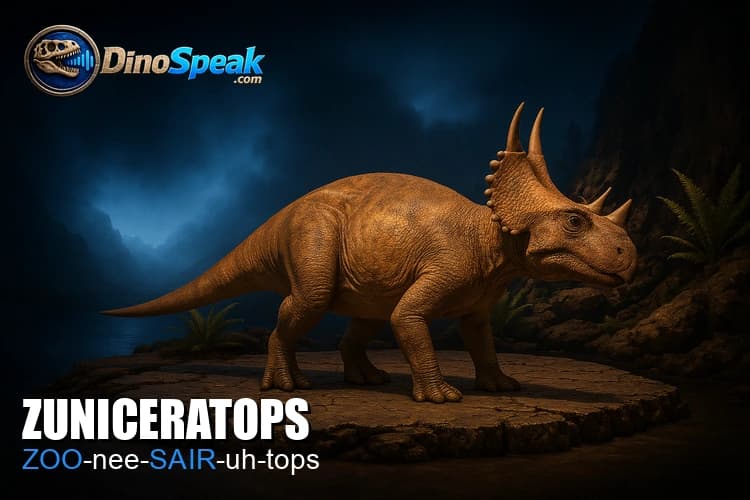
What does Zuniceratops mean?
Zuni horned face from New Mexico
Name Roots
"Zuni"
named after the Zuni River and the Zuni people of New Mexico, USA
"kerat-"
horn, from Greek 'keras' meaning horn
"-ops"
face or eye, from Greek 'ops' meaning face or appearance
Fun Facts
- ✓Zuniceratops was discovered in 1996 by an eight-year-old boy named Christopher Wolfe, and the species was named 'christopheri' in his honor, making it one of the very few dinosaurs named after a child.
- ✓At roughly 89.8 million years old, Zuniceratops fills a critical 30-million-year gap in the fossil record of horned dinosaurs in North America, helping scientists understand how Triceratops and its relatives evolved their spectacular horns.
- ✓Unlike the giant ceratopsians that came later, Zuniceratops was relatively small, roughly the size of a large bear, suggesting that huge body size evolved separately in the ceratopsian family after their ancestors crossed from Asia into North America.
- ✓Zuniceratops had genuine brow horns over each eye, a feature previously unknown so early in North American ceratopsian history, which completely rewrote the evolutionary timeline of horned dinosaurs when it was formally described by Douglas Wolfe and James Kirkland in 1998.
- ✓The fossils of Zuniceratops were found in the Moreno Hill Formation of New Mexico, a rock unit representing a lush coastal environment near the Western Interior Seaway, meaning this horned dinosaur lived right on the shoreline of an ancient inland sea that split North America in two.

Period
Late Cretaceous (Turonian)
89.8 MYA
Diet
Herbivore
Size
10 ft (3 m)
440 lbs (200 kg)
Type
Ornithischia