Stethacanthus Pronunciation
Picture, name meaning, and how to say Stethacanthus. Free guide for kids and parents.
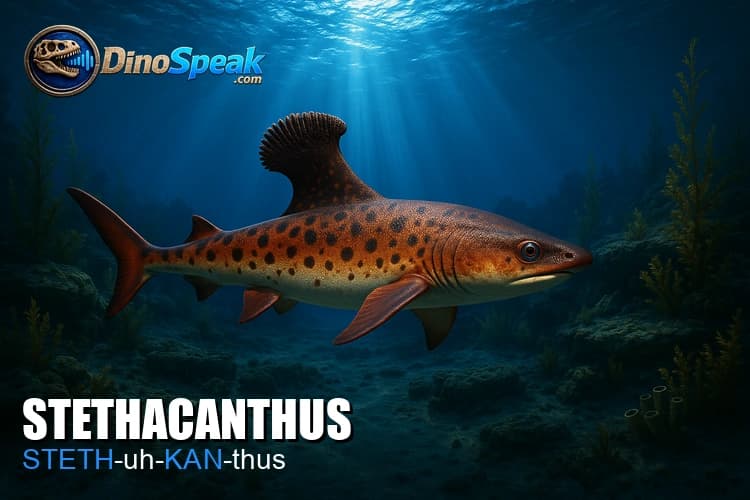
How to Pronounce Stethacanthus
STETH-uh-KAN-thus
ALL CAPS = stressed syllable
What does Stethacanthus mean?
Chest spine or breast thorn fish
Name Roots
"stethos"
chest or breast (Greek)
"akantha"
spine or thorn (Greek)
Fun Facts
- ✓The anvil-shaped spine on Stethacanthus's back was coated in tiny sharp denticles, exactly like the ones on top of its head, making scientists think the two surfaces could interlock like Velcro when the shark pressed its head to its back.
- ✓Stethacanthus lived alongside the first forests on Earth during the Carboniferous period, when oxygen levels were so high that giant insects like Meganeura, a dragonfly with a 2-foot wingspan, ruled the skies above the seas where this shark swam.
- ✓The strange spine-and-head-patch combo appears to occur only in male Stethacanthus fossils, leading scientists to believe it was used for mating displays or competition, much like a peacock's tail, making it one of the earliest known examples of sexual dimorphism in sharks.
- ✓Fossils of Stethacanthus have been found on nearly every major continent, meaning this small ancient shark was one of the most geographically widespread creatures of its time, surviving for roughly 60 million years.
- ✓When Swiss-American naturalist Louis Agassiz first described Stethacanthus in 1844, he had only isolated spines and teeth to work with, and the full bizarre body shape with its anvil crest was not known to science until much more complete fossils were discovered in Scotland and Montana much later.

Period
Late Devonian to Late Carboniferous
358-299 MYA
Diet
Carnivore

Size
2-4 ft (0.6-1.2 m)
approx. 5-15 lbs (2-7 kg)

Type
Chondrichthyes