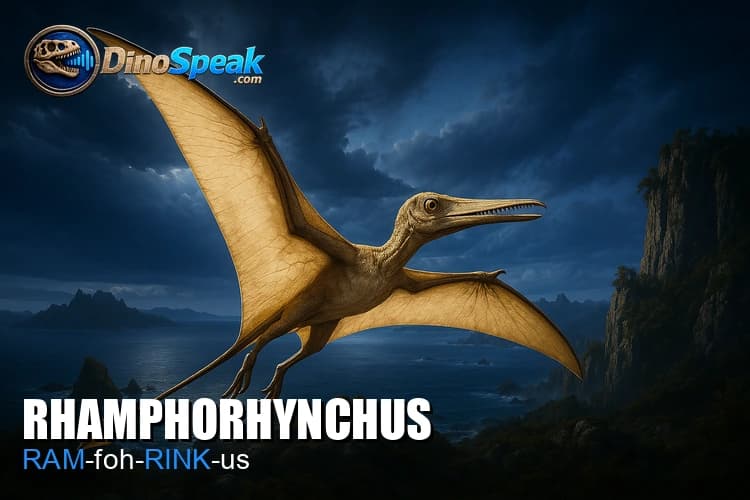
Rhamphorhynchus Pronunciation
Picture, name meaning, and how to say Rhamphorhynchus. Free guide for kids and parents.
How to Pronounce Rhamphorhynchus
RAM-foh-RINK-us
ALL CAPS = stressed syllable
What does Rhamphorhynchus mean?
Beak snout, for its pointed jaws
Name Roots
"ramphos"
beak or bill, from Ancient Greek
"rhynchos"
snout or muzzle, from Ancient Greek
Fun Facts
- ✓The tail vane of Rhamphorhynchus was made of soft tissue, not bone, which means it is only known because of exceptionally preserved fossils in the Solnhofen Limestone where even skin impressions survived.
- ✓Scientists have found fish bones and squid-like cephalopod remains actually inside fossilized Rhamphorhynchus abdomens, giving us a direct grocery list of what it ate for its last meal.
- ✓One famous fossil nicknamed the 'Rhamphorhynchus in the belly of a fish' shows a large predatory fish called Aspidorhynchus that had caught a Rhamphorhynchus, only to choke on it and die itself, leaving both animals fossilized together.
- ✓Rhamphorhynchus had teeth that angled forward like fish hooks, almost certainly an adaptation to snag slippery, struggling fish mid-dive without letting them slip back out.
- ✓Rhamphorhynchus lived at the same time and in the same skies as Pterodactylus, but the two pterosaurs were actually only distant cousins, with Rhamphorhynchus belonging to the older, longer-tailed family group.

Period
Late Jurassic
154.8–143.1 MYA
Diet
Carnivore
Size
~3.9 ft (1.2 m) wingspan
~0.5 lbs (0.2 kg)
Type
Pterosauria