Coronodon Pronunciation
Picture, name meaning, and how to say Coronodon. Free guide for kids and parents.
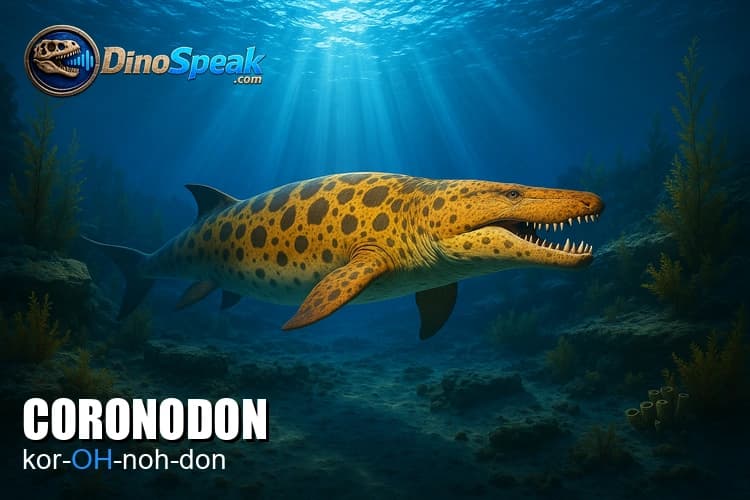
How to Pronounce Coronodon
kor-OH-noh-don
ALL CAPS = stressed syllable
What does Coronodon mean?
Crown tooth, ancient toothed whale
Name Roots
"corona"
crown (Latin): referring to the crown-shaped cusps on its teeth
"odon"
tooth (Greek): indicating this animal had teeth, unlike modern baleen whales
Fun Facts
- ✓Coronodon lived approximately 28 to 23 million years ago during the Early Oligocene epoch, making its fossils some of the most scientifically important prehistoric whale remains ever found in North America.
- ✓Unlike any living whale today, Coronodon had large, complex, multi-cusped teeth with crown-like ridges that could interlock and act as a sieve, meaning it was caught right in the middle of evolving from biting to filter-feeding.
- ✓All known Coronodon fossils come from just two rock formations in South Carolina, the Ashley Formation and the Chandler Bridge Formation, making the American Southeast ground zero for understanding early baleen whale evolution.
- ✓Scientists formally described Coronodon havensteini in 2017, and since then two additional species, C. newtonorum and C. planifrons, have been identified, showing this was a diverse group of transitional whales, not just a single oddball.
- ✓Coronodon belongs to Mysticeti, the same group as today's blue whales and humpbacks, but it was a toothed member of that group, proving that the ancestors of the world's largest animals once had a full set of teeth.